Three recent articles on Poets & Quants caught my eye:
– ‘AI IS DEVALUING THE MBA’: Stanford Students Speak Out On Curriculum Lag & Risk To The B-School’s Brand.
– ‘WE EXPECTED MORE’: Stanford GSB Students Call For Higher Teaching Standards.
– ‘WE’RE NOT LEARNING ANYTHING’: Stanford GSB Students Sound The Alarm Over Academics.
These articles are partly about Stanford and partly about the MBA. But they are all about change and the response to change.
For me, the most surprising finding was that professors send “Room Temp” lists alerting students they will call on in class the next day. One Stanford student explained what that does: “It teaches them that they don’t have to read or prepare before class if they’re not on the list.”
I went to a different b-school at a different time and can’t imagine the situation in those articles. But I also get that profs react to situations where both students and administrations may not support having standards.
Some situations I experienced in b-school:
One stats prof was known as the angry guy. One day he went down the row cold calling students:
“What’s Benford’s Law?”
“Uh…”
“It’s in the textbook!” To the next student: “What’s Benford’s Law?”
“I don’t remember.”
“You didn’t do the reading!” Next student: “What’s Benford’s Law?!”
“I don’t know.”
“You gotta read the textbook! Why didn’t anyone read it?!” he screamed.
But that same prof had us hand calculate each step of a linear regression – something that Excel does instantly. And if you’ve never done it you might have no idea what a regression is and what Excel actually does.
In a popular class with 300 students, there was no “Room Temp” list, but the prof would start by calling five names. If your name was called you were presenting the case, no matter what. When the names were called, everyone else would let out a sigh of relief.
I saw people stand for 45 minutes being grilled on particulars they seemed to know well at the start of the hour.
One time as a student made his case the prof stopped him: “See this guy? He’s going to be an investment banker. At some point you’ll meet someone like this. They will throw you under the bus and expect you to thank them.” Everybody laughed (and nobody complained to the administration).
As it did a generation ago, the MBA will be reinvented again. The previous reinvention moved away from the expectation students would take stable corporate jobs. The current reinvention could be about attitudes/standards and AI.
Is some of the situation in the above articles about the slowness to adapt class material? For the last 2.5 years I’ve required AI in my classes. But that also means that you need to change the class itself. If you just tack on AI to an old course it won’t really work.
Or is some of the Stanford situation what comes to the surface in a time of high unemployment for recent MBA grads? Was the situation there earlier but ignored when job prospects were better?
So many ways to learn today.
Category: thoughts
A collection of thoughts about entrepreneurship and company-building.
-
AI Impact in Education
-
The Bat and the Can

If you’ve seen any sports news recently, you probably heard about the new “torpedo bats” the Yankees are using and how well they seem to be working.
It’s a simple redesign. By redistributing weight away from the end, the bat delivers more mass at the point of contact, resulting in farther hits.
The idea came from physicist Aaron Leanhardt, who was working as the Yankees’ hitting coordinator. As he put it: “I think the eureka moment… was when players pointed to where they were trying to hit the ball, and they noticed themselves that that was not the fattest part of the bat.”
What struck me wasn’t just the bat redesign. It was that I had stopped thinking of bats as something that still had room for innovation. The last example that came to mind? The corking scandals from the 1990s and early 2000s. But unlike corked bats, torpedo bats are legal.
Now for the can.
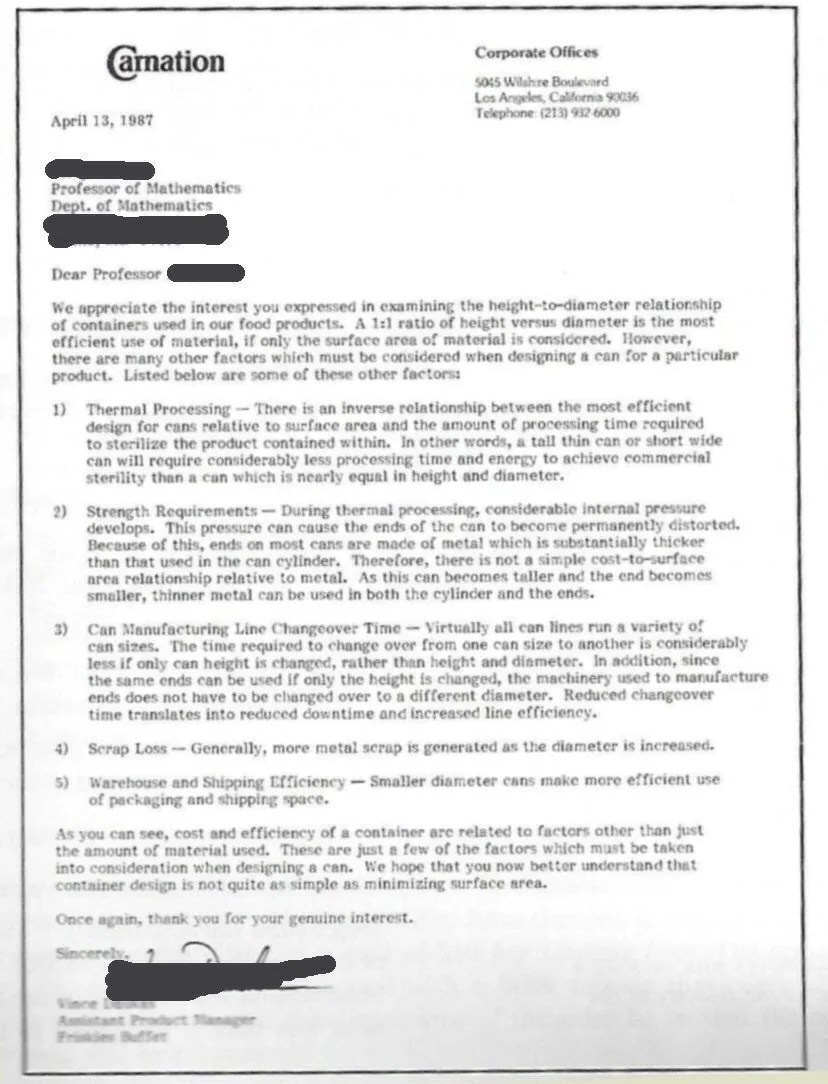
The other half of the title refers to a well-known letter sent by Carnation to a math professor who had proposed a 1:1 height-to-diameter redesign for their cans. His suggestion was to minimize surface area and therefore material use, but ignored other constraints.
“We appreciate the interest you expressed in examining the height-to-diameter relationship of containers used in our food products. A 1:1 ratio of height versus diameter is the most efficient use of material, if only the surface area of material is considered. However…” Then the letter goes on to explain that issues such thermal processing, strength requirements, line changeover time, scrap loss, and more. The solution is not related only to surface area.
The difference between the bats and the can?
In the case of the bats, the innovator started off by knowing the user (the hitters) and then worked with them to create a solution. In the case of the proposed can redesign, the potential innovator lacked that and missed the bigger picture.

-
The Rejection Exercise
For years I’ve been making founders do 30 days of rejection, where they purposely go out and try to get rejected at least once a day. The purpose is to toughen yourself up so you’re not broken by hearing customers / investors / collaborators say “no.”
That’s the general format, but in recent years, I’ve done something different.1) I do the exercise along with them.
2) I use AI to analyze the results (the recent group of 34 founders produced almost 1000 results).
These are the exact steps I used for this one.
1. Provide detailed instructions for how to pursue the rejections, including the document format to save them in.
Rejection Exercise
Rules:
– You must be rejected in person (not online, by phone or remotely) by another person at least once, every day for the next 30 days. Don’t just go through the motions on this. See how you can top yourself each day.
– A rejection counts if you are out of your comfort zone.
– A rejection counts if your request is denied.
– Try different types of rejections, not the same one again and again.
– Do not pursue ridiculous rejections, like “Can I have a trillion dollars?”
– At the time of rejection, you, not the respondent, should be in a position of vulnerability. You should be sensitive to the feelings of the person being asked.
– For this assignment you cannot involve any others in the group, including me!
– Fill out the rejection exercise template.
2. After 30 days, download the results.
3) The AI analysis.
Prompt: Read the attached zipped folder. Analyze the numbered (1 – 30) lists in the docs. Look at columns titled: “What you said”, which is what the people said to get a rejection and “Their response”, which is what the person they spoke to responded with. Make a summary of these exchanges. What patterns do you notice from the exchanges? Which people had the most extreme rejections? Add other things you notice that make sense in this context.
4) What to do differently next time.
– Provide analysis summary beforehand to inspire bigger asks and for context.
– Put instructions in template document (10% changed the filetype, which caused problems.)
– Reward the biggest asks and best rejections.
5) Output: Success rate for different types of asks
-
More on Gen AI Usage in Entrepreneurship
For the last 2 years I’ve made gen AI mandatory in the classroom, but this semester there were so many useful AI tools and other techniques that I brought them in more heavily.
A few examples from a class of grad students testing and potentially launching new businesses:
Problem: I had the student founders start off with more practice on customer discovery interviews. Many of them have done interviews like this in the past, but I often noticed that they either never knew how to do them well or forgot in the moment. The problem was partially educational, but mainly in terms of getting the practice of how to do them well. And that’s the kind of thing you don’t have enough time for in a class.
Solution: I have founders train an AI to analyze their interview questions and give feedback, specifically looking for common problems like hypothetical questions, forward-looking statements, and more.
Problem: Founders do their discovery interviews and then don’t adequately record responses. As long as I’ve done these I have relied on handwritten notes, whether paper or laptop. But in the past when I sat in on these interviews (pretending to be part of the team) I noticed many different things than showed up in the notes. Also, how do you generate transcripts without spending hours typing?
Solution: Now we record the interviews. I’ve been convinced that enough people have become comfortable being recorded that it’s doing just that. Afterward, we analyze the recordings. Audio alone is fine. That gives a deeper understanding of what people are revealing along the way. And the transcripts can be ~80-90% done with AI transcription.
Problem: How do you really assess whether you have a potential and ready customer? Many times it seems like the founders will just move ahead on anything. That’s actually ok as it’s their decision how to spend their time, but if they want to move in the direction that feedback is guiding them, they should think about what they’re learning through the process.
Solution: For this I use a technique developed by Mike Vladimer and Adam Berk – looking for “people in pain.” Specifically, they recommend building a quantified pain histogram and charting the positive, negative or non-existent pain uncovered. I’ll also be interested to test whether a trained AI is good enough at evaluating these interviews.
You don’t have to use every new tool, but try some of these out. -
Corporate Innovation Approach
None of the successful company CEOs I’ve worked with seek out innovation for innovation’s sake. They are after something else instead.
In an uncertain environment, with pressure to grow their business, how should they evaluate opportunities?
The last 20 years have left us with new tools and frameworks to evaluate opportunities for business growth. You probably know many of them…
Understanding the customer, future customer, potential customer. Studying Disruption Theory and Blue Ocean Strategy. Determining whether you are (or will operate) in an existing market, resegmented market, or new market. Understanding your business model type, such as direct, indirect, or marketplace. The way you look at trends. Even learning from copycats…
Then there are common ways to bring innovation in house in order to grow. Companies organize hackathons around their industry or tech. Longer-term efforts include the launch of an internal accelerator or incubator program. There are many flavors of these programs. I should know — I’ve operated three different accelerator programs, with three different focus areas, on three different continents. An internal program done well can support early-stage teams, provide access to high-level contacts, access to customers, and expertise. It can also be a distraction and produce minimal results.
What these in-house programs also can offer is a portfolio approach to new projects. But running in-house accelerator, incubator, or innovation programs can be difficult to do at scale. What other approach could we use?
I think in terms of maximizing “shots at goal.”
Dilemmas and distractions
Years ago when I worked in a new group at AT&T that was operating a new service to displace legacy business lines, we needed to operate separately from other divisions. We were culturally and financially at odds with the rest of the legacy business run by other parts of the company. Our main competitors were actually other departments of AT&T. I used to think this internal competition was an anomaly, but after time at other large organizations, from financial services to a university, I see how common it is. My own winning strategy for dealing with this: ignore the competition and focus on customers.
Most do not take that approach. One company I know has run over 30 innovation projects without gaining a single customer. Each project was the brainchild of someone in-house. Each project had a budget. And none of them spoke to customers before spending on R&D and production. Result: years wasted, millions wasted, and jobs lost.
As a friend mentioned, his Fortune 100 company has his team wear jeans and play foozball once a week in order to encourage creativity… I may be too quick to dismiss this behavior. Sometimes good things come just from getting people together in a low-stress environment. But the good things that come may be haphazard and not replicable.
What has irreversibly changed
In the last 20 years since the dotcom bubble, the cost to build a startup or new business has fallen by 100x – 1,000x due to fewer upfront costs, commodification of common processes, and better ways to test concepts. Speed to build has increased by 10x – 100x due to commodification of common tech components and processes and new programming languages. While it’s always going to be difficult to build a big business, getting the small ones started is easier. These changes are here to stay. But in spite of the above changes, if startups themselves don’t work out most of the time, why should we expect corporates to be significantly better?
If we take a process-driven approach, there are new ways that larger companies can test new business concepts and opportunities at scale.
Improve your odds of being right. Reduce your cost of being wrong.
As with the decreased cost and time to build mentioned above, the cost and time to gather useful insights from potential customers has also fallen. Over the past 15 years we’ve come to understand and apply customer discovery interviews as a way to learn. What’s changed beyond customer input in more recent years is the ability to test in rapid iteration, for example by going off-brand and testing multiple product concepts through targeted online ads. The speed of data collection and ability to make modifications is orders of magnitude beyond what earlier versions of this method could achieve years ago. This is rapid experimentation. Start with customer insight, generate five concepts, expand those into 50, test those with ads or low-fidelity MVPs, look for early metrics of success, double down on the more promising ones, and only then short-list the most promising handful for prototyping. Depending on complexity, this rapid experimentation process could take as little as three to six months and be significantly less expensive than betting all on a pre-selected small number of concepts from the start. More shots at goal. Lower cost.
You never eliminate risk, but what is risk after all? Risk is the cost of being wrong. If you are able to lower your downside by decreasing your upfront investment and also increase the odds that you make the right bets, then you have decreased your risk. If you take a portfolio approach to testing concepts and move quickly, you can also improve your odds of building something big.
After my experiences working at Fortune 100 companies, and more recently working with hundreds of startups, I want to bring what I’ve learned to larger organizations. Let me know when you’d like to talk.
-
Calculating Critical Mass
You’ve probably heard the term “critical mass” tossed around when discussing startups (especially ones like social media products). The term is usually either used in the form of “we reached critical mass and then things just took off” or “we don’t have critical mass and we can’t grow…” But what is critical mass? How do you calculate it? And what is therefore the number of users that these products need in order to have it? Critical mass is different from “product/market fit,” another loosely defined term, in that there is a number we seek, even if no one admits to knowing what it is. With product/market fit there is no minimum number — your business just ends up growing faster than you can handle.
It’s also good to think of what critical mass does not mean. It doesn’t mean that your business is cashflow positive, that you have good margins, or that you have lots of users. It’s something else — the point at which you have enough users or usage to keep sustain the product.
How did we get here?
The term critical mass does not originally come from social products or startups. It comes from physicists studying nuclear fission. Basic introductory definition: “A critical mass is the smallest amount of fissile material needed for a sustained nuclear chain reaction.” Read at least the Wikipedia article and try out the equations.
Many things impact critical mass in nuclear fission. From Wikipedia again, the following can change the point of criticality: Varying the amount of fuel, Changing the shape, Changing the temperature, Varying the density of the mass, Use of a neutron reflector, and Use of a tamper.
In other words, in fission, the critical mass is not static. It changes depending on those other factors. Here’s the nuclear fission critical mass formula.

Where M is the total mass, m is the nuclear mass, s is 1 + the number of scattering events per fission event, ẟ is the total interaction cross section, ⍴ is density, and f actually is a fudge factor (their words, not mine) that accounts for geometrical and other effects. If the value is 1 or greater, the fissile material with go into a critical mass chain reaction.
Once I saw that fudge factor, I stopped feeling so bad about only trying to come within an order of magnitude when it came to critical mass for a social product.
The above ways to change the point of criticality of fissile material are each pretty instructive too.
- Varying the amount of fuel. The most direct way to think about a minimum amount of stuff needed to attain the critical mass chain reaction.
- Changing the shape. That is, a thin layer of fissile material will not reach critical mass, where the same amount rolled into a ball may achieve it.
- Changing the temperature. This is mostly related to expansion.
- Varying the density of the mass. Less dense: more needed to become critical, if it can become critical at all.
- Use of a neutron reflector. Sending escaped neutrons back at the fissile material to get another chance at causing a chain reaction.
- Use of a tamper, another way to send escaping neutrons back at the core.
You might even start to see some similarities in how we could look at critical mass in a social product.
But of course, the above equation isn’t completely relevant for social products. Humans are different from atoms. It’s tough to make a critical mass calculator without thinking through those differences. But it is a starting place. But when a term doesn’t have a clear definition people start to apply it loosely, so I’m going to rewrite the critical mass formula, with human users in mind rather than molecules.
First, how do we define critical mass for a social product without relying on “you know it when you have it, because then everything goes well” type of circular reasoning? My critical mass definition is the minimum number of users you need to sustain user value in the product with no other product changes. This is product critical mass, not business critical mass. Critical mass in business (when your customers make the business sustainable) will almost always be much higher.
Even if we disagree on how to calculate critical mass, we can say that we don’t have it if a product becomes less valuable in aggregate for its users over time when there is no other change to the product itself. (There are many products that barely changed over years but where value remained, Twitter being a modern example.) So, not having critical mass should result in less action per user over time, even if the total number of active users stays the same. Having critical mass should mean that we maintain our users and most likely grow them — churn will be low and more people are likely to want to join.
What is the point at which user behavior means that the product sustains itself? That is, factoring in how much people use the product as it makes sense to your business (like messages sent, interactions, referrals), plus users lost through churn.
Estimating critical mass for a social product
The purpose is to answer these questions:
- Do we have critical mass at the current number of users? If not and if all else about the product and usage remains the same, what number of users needs to be added?
- Do we have critical mass at the current amount of usage? If not, what do we need to change about usage in order to have critical mass at the current number of users?
For now, my inputs are these:
- Percent of users active in time period. We can imagine two different products, one with a high percentage of active users (could be because of recency or other factors that keep people engaged) the other with a low percentage of active users (low need to log in). A higher percentage of active users can sustain a smaller overall population of users. So critical mass would be lower if active user percentage is higher.
- Necessity and expectation of frequency. Some social products (like a microblogging service) only make sense when there are frequent new contributions from many users. Messaging apps or SMS, can have critical mass with smaller engaged populations (the extreme being just two people to send messages back and forth). Other services have much lower, or different, requirements (like a time-based app where users aggregate at specified times of day). Overall, a larger critical mass will be needed when a population is spread around every time zone. A smaller critical mass will be needed when a population is concentrated around a smaller number of time zones. That is, if there is a natural busy hour for activity shared by the user population, fewer people will be needed to attain critical mass.
- Activity per user. Do users browse the content of others or do they also contribute?
- User activity needed to cause a reaction from another user. What does it take and how do you measure and encourage it?
- Percent of users who take an action in time period. Features such as the “like” makes it easy to take an action with a single tap.
- Impact of messages received on messages sent percentage. This is similar to the probability that a fission event creates other fission events.
- Other users’ impact on retention or churn. Likelihood to remain active if user receives action from another in time period
- Amount of value from single-player mode or other way to get value without user interaction. This enables the product to attain critical mass with a smaller number of users.
- Unaccountables. Time, place, UI / UX, subpopulation peculiarities, and other issues that act unpredictably. If the physicists used a fudge factor, I will too. This is also why I’m happy estimating this within a factor of 10x for now.
I’m not going to write a formula now, because I’m still thinking through the variables and am figuring out how to weight them. What I’d really like is some actual data to test against. Want to contribute? Please get in touch here.
But in general, I’m expecting something like these variations:
- Messaging app like texting: two people minimum in the extreme example. This is the one that will cause the most disbelief. Remember, we’re not looking for what sustains the business financially. Depending on your revenue model, those numbers can be dramatically different anyway. Instead, we’re talking about what sustains the product. In this extreme case, just two people could sustain usage and get value from the product and then go on to invite others in.
- Messaging app like Slack: 10x the above for one group. That’s enough for value from the small crowd, info from the group leader, plus enough people you want to talk directly to for one-to-one messages.
- Broadcast / microblogging service like Twitter: 1,000x the above. That’s enough for value from the crowd plus enough people you want to message directly.
The above are the best case scenarios (lowest critical mass numbers), given the variables. In most cases, where the product still needs work, the numbers will be much higher.
But I’m making the assumption that there is some predictability here that leads to better understanding users and systems. I might be wrong and there typically is not enough that can be predicted. But if we can improve our guesses, then talking about critical mass will shift away from being a loose concept and could carry more value as something at quantifiable, at least within bounds. I’d love to look at actual data of social products at their critical mass tipping points. If you have anonymized data you’d like to share, please contact me so we can refine the theory alongside actual results.
How can you reach critical mass for your product?
You can’t get there in one step, so here are a series of steps that help:
- Increase retention. Critical mass requires high retention for different reasons than typical, such as the increased costs of acquiring new users. Focusing on critical mass, you want retention to be high because repeated usage by the same users is better than occasional usage by different groups of users.
- Increase engagement. In the social media examples above, fewer users that are engaged can make up for more users that are not engaged. Because some products depend on the relationships between users, a small group of highly engaged users produces an effect that is preferable to a large number of unengaged users.
- Understanding the business you’re in. In marketplace services, a balance between supply (for example sellers on ecommerce sites, or drivers on rideshare) and demand (buyers on ecommerce or passengers on rideshare) is so important that these services are often careful how they launch. A marketplace startup will have an easier time focusing on one product category or one geography rather than launching with everything, everywhere.
-
The Most Common Problems (University Student Version)
I just finished teaching my tenth college course over three and a half school years. Across those 10 courses, I’ve had approximately 350 students in my classes.
During and after every semester I try new formats and reflect on what I should change, based on what’s working and who happens to be in each class. After 10 courses, it’s time to more seriously reflect on common areas of trouble for students. I make the claim that if these problems could be removed, then everyone would learn more quickly and more overall.
Don’t mistake this for a complaint. I’m presenting what I observed over these 10 groups of students. And don’t mistake this for a indictment of millennials. Overall, I’m impressed with this generation. Instead, let’s look at the point at which I see them – as students in a top university before they have started to work.
Lack of math skills.
This was the biggest surprise for me. Around half of the typical class population is not comfortable with math – and here I mean business math. Nothing sophisticated, no calculus or number theory. Just comfort with using addition, subtraction, multiplication, division, exponents, and percentages. Ability to do some of that in your head.
Ability to memorize formulas and apply them in other situations. This subcategory of the above turned out to be a huge problem. When I was a new professor I spoke to a colleague who had just given a pop quiz on topics that the class had discussed for a month. Everyone in the class failed. My colleague must be a terrible teacher, I silently concluded. I decided to try the same thing and handed out a pop quiz based on topics the students had confidently discussed for a month. Class average: 48%. I was shocked, but showed the answer key, went through the questions again, and told them to expect another pop quiz sometime. One month later I gave the exact same quiz. Class average: 70%. That result led to one of the biggest changes I made in university teaching. I call it “tricking people into learning.”
Estimated time for a student to improve to adequate level: 20 hours.
Belief that they don’t need to memorize and internalize formulas and definitions.
Without the memorization, you often fool yourself into believing that you understand and can apply the knowledge in different situations. This is one area that should have the biggest ROI on student time.
Estimated time for a student to improve to adequate level: 2 hours.
No knowledge of Excel.
If there is one tool that you’ll use after graduation, it’s Excel. For the record, I love Excel. Sure, there are more powerful programs that do similar things, but for accessibility and universality, Excel still wins. One of the good random things that happened to me was for me to find an Excel manual during an early management consulting project that was going slowly. I spent a good part of each day reading it and trying out formulas. Finding that book easily saved me hundreds of hours over the years. Now, while I do teach within a business school, perhaps half of my students come from other areas of the university – engineering, communications, cinema, arts and sciences. The lack of Excel knowledge, and the pain with which they learn it, are just too extreme. Even the ones who have taken accounting classes, a student told me, do their accounting spreadsheets by hand. I do not believe that that hand work is intentionally there to guide them into better understanding of business accounting.
Estimated time for a student to improve to adequate level: 10 hours.
Ability to stay focused in class without devices.
I have tried every combination of device usage in my classes including no usage, total usage, usage only when we read a case study and on and on. Hands down, zero usage wins. Note that I teach undergrads and this finding may not hold for grad students. I also teach an elective that is more quantitative and based on using online tools. In that class I deal with laptop usage for class. But in my other class, which is a required class for the entrepreneurship minor, I have banned devices and laptops once and for all. After doing so, students become better at thinking on their feet rather than simply looking up a response, they have better discussions with other classmates, and they don’t need to avoid online distractions because they’re not online.
Estimated time for a student to improve to adequate level: n/a.
Ability to communicate well.
In general, the students are pretty good at standing in front of the class and presenting their projects. This is something I only had to do once in my time as an undergrad. For today’s students, in-class presentations are pretty common and their confidence shows. The area they could improve, or eliminate problems from, is in written communication.
The first area is email. I receive a good number of emails which start with the word “Yo,” or “Hey,” or which are tough to read because, I have to hope, lack of effort rather than lack of ability.
The other area is writing longer papers. Lack of proofreading, spelling mistakes, using voice-to-text (it shows) make otherwise smart students look pretty bad. The proofreading and spelling mistakes are easy to fix with software. Being able to write well though… Commit to reading lots of good books and articles and writing thoughtfully over years.
Estimated time for a student to improve to adequate level: 1,000 hours.
Other Tangents.
The most common question students bring up when we go off on larger issue tangents. Is a university degree worth the high cost of tuition? I reflect that I could take one half of the number of students I currently teach, charge them half as much a credit as the university does, and provide a better learning experience while also earning more. This is a reality that the American university will be forced to deal with in the next generation. It’s going to be fascinating as the change happens. What will replace the university network though I don’t know.
I am not a university academic. Becoming a professor was entirely accidental for me – I never applied for the role, but because of previous work experience was asked to teach. I’m glad I did. Teaching has changed the way I express ideas and think about their impact.
New changes. Since there has been so much similarity in the way different classes of students struggle with my classes, next semester I will distribute a list of likely problem areas. Avoid these and you will improve your chances dramatically. History suggests only a 20% class body follow-through on the offer, but I’ll take it.
-
Monopolies I Have Known
In light of Mark Zuckerberg’s Congressional testimony (and Facebook’s own natural monopoly) I reflected on some of the monopolies I’ve known. Given what Facebook does I focused on communications companies, which historically were somewhat close to what social networks of today provide.
AT&T’s government granted monopoly
We trace this back over 100 years to the Kingsbury Commitment of 1913. That agreement set out the rules for AT&T’s place as the US’s national carrier and how it needed to work with local service providers. In the early days of communications technology build-out, national governments often stepped in to guide (or control) what telecommunications companies were able to provide which services and for what benefits of the population.
AT&T however was known as a “gold-plated” monopoly. Phone service in the US extended to rural areas that were more expensive to build out (not a condition seen in every other country) and the degree of innovation coming out of the company was dramatic. Some of their innovation portfolio includes dial tone, mobile telephony (car phones originally), the transistor, Unix… This gold-plated aspect led to some interesting experiments in employee training, including a foray into teaching the humanities (see The Organization Man Goes to College: AT&T’s Experiment in Humanistic Education). This investment in employees is comparable to Peter Thiel’s argument that companies like Google are also monopolies — and that’s why they take care of their employees.
Telecommunications hardware used to be much more locked down than today. It used to be illegal, then uncommon, to own a landline phone in the US. AT&T rented them. The monopoly granted AT&T allowed the company to regulate any devices that connected to their network — a term that was interpreted loosely. Legal action by AT&T to enforce its monopoly dominance included preventing a company called the Hush-a-Phone (basically a cup that fit on top of your telephone handset in order to shield the speaker’s voice) from selling its products. Why go to such lengths to prevent this physical product from existing? If you have near total control, any little step away from that is problematic.
Interestingly, Peter Drucker argued against AT&T’s monopoly breakup in 1984, but on behalf of national security. The national security and telecommunications infrastructure and equipment issue is still a concern today (actually part of an ongoing concern for at least the last 20 years) with Chinese equipment provider Huawei.
The swing of general communications technology moved from government enforced monopoly to decentralized.
China Telecom
China Telecom has a much shorter history than AT&T and being based in a different country with different needs and at a different time, competition to this monopoly came in different forms. An early competitor was China Unicom, which in the mid-1990s had low single-digit market share overall and market penetration in just a few urban areas. The company was dependent on China Telecom for national interconnections (which sometimes was cut). Starting in 1998, China (as did other parts of the world) started to allow more companies to offer telecommunications services, initially through (lower quality) Voice Over IP (VOIP) calls. These early calls were not like the Skype you later came to know. Rather, the caller would dial the number of a local gateway and then their destination phone number (basically operating like a calling card except that the voice traffic was routed at least partly on an IP line). Later enterprise implementations were seamless and did not require the caller to dial multiple phone numbers. I remember various Chinese government agencies during this time exploring VOIP network rollout, some with official licenses, some because the founder’s relative was so-and-so and they were operating in the grey market (many long stories there).
Impact to the consumer — the official and later market determined price of a phone call dropped significantly. Back in 1997, the official rate to call from China to the US (something very few people ever did) was US$1.30/minute. During that time I knew someone who was arrested for offering cheaper non-official services. By 2000, the rate had fallen to around $0.10/minute. It’s been basically free for years now.
In China, total subscribers (both fixed and mobile) was 7 million in 1990. The number of just mobile subscribers in China is now 1.6 billion. Yes, that’s more than the total number of people in China. More and more countries have mobile phone penetration of greater than one per capita. Oh, and Unicom later went on to build an enormous VOIP and mobile network.
Other countries have dealt with communications technology in different ways. In Myanmar (then Burma) people went to jail in the 1990s for illegal possession of a fax machine or a modem (the Internet was only made legal there in 2003). These actions (as elsewhere around the world) were more based on protection government communications control than consumer access.
The above were state granted and regulated monopolies. However, we could also think about how else the initial national communications infrastructure might have been built out around the world.
Now back to Facebook. One of the interesting exchanges from the Senate hearings was this one between Zuckerberg and Senator Graham:
Graham: Who is your biggest competitor?
Zuckerberg: Senator, we have a lot of competitors.
Graham: Who’s your biggest?
Zuckerberg: I think the categories — did you want just one? I’m not sure I can give one. But can I give a bunch?
Graham: Mmhmm.
Zuckerberg: There are three categories that I would focus on. One are the other tech platforms, so Google, Apple, Amazon, Microsoft; we overlap with them in different ways.
Graham: Do they provide the same service you provide?
Zuckerberg: In different ways, different parts of it, yes.
Graham: Let me put it this way: If I buy a Ford and it doesn’t work well and I don’t like it, I can buy a Chevy. If I’m upset with Facebook, what’s the equivalent product that I can go sign up for?
Zuckerberg: Well, the second category that I was going to talk about —
Graham: I’m not talking about categories. What I’m talking is the real competition you face.
Other articles don’t focus on this point, looking at social networking businesses across different markets and usages. If you think of just the casual, social pieces of peoples’ lives, what is the biggest social networking competitor to Facebook?
Sources of Monopoly Power
The list of sources of monopoly power in which Facebook is strong includes: no substitute goods, network externalities, and increasingly technological superiority and manipulation.
Facebook has an advertising revenue model. Therefore, anything that interferes with the company from earning ad revenue from their user generated content is likely to be seen as a threat. In 2008, Power Ventures, a social network of social networks was sued by Facebook on multiple counts (another interesting take is here). Part of the case is still pending. What did Power Ventures do to draw Facebook’s attention? They enabled users of Facebook and many other social networks to see all of their feeds in one place — and without the original social network generating, or being credited for, the advertising. Good for the users (convenience) but bad for the ad-based companies.
In its 2017 annual report, Facebook shows 184 M daily active users in US and Canada — the smallest number by any of their regions, which are all more populous. By revenue, however, it’s the reverse. The US and Canada, having more developed and profitable advertising markets and what seems to be more frequent usage, generate the highest per user revenue (over $84/user in the US and Canada for the 2017 annual report’s most recent four quarters, p 38). Facebook’s social networking ad revenue market share approaches 80% in the US.
I won’t go into the details on the Cambridge Analytica scandal, with which anyone reading this far probably already has background. If it weren’t for Cambridge Analytica, when would Zuckerberg have testified to Congress? It would have come eventually.
-
What Is Value?
The Fundacio Joan Miró is located quite a ways up a hill in Barcelona. Years ago I was dropped off there by a cousin who, knowing I had no phone, didn’t return for 10 hours. I was ready to leave after 30 minutes. The artist Joan Miró wasn’t even close to full-day interesting to me when I walked in. But that day did more than teach me Miró’s ideographic language and make me love his work. I now know that day was the start of me rethinking everything I believed about value.
We often intuitively have a feeling for the value of something. What it should cost. What a fair price is. But those feelings change based on context and vary widely person to person. The hardest part of the intuition to let go of is the knowledge of what something cost to make. Consider this dialogue about how an artist prices his art, from the movie Great Expectations:
“Do you charge by the inch or by the hour?”
“What?”
“How do you price your art? By its size, square footage, or the time it takes to make the art?”
“I’ve actually never sold a painting.”
Even if we don’t have a feeling for the value (meaning cost or price) we often think we know what the value to others is. In business model territory, the Value Proposition describes what customers gain from your product. What they value may be different from what you value. Actually, it’s probably generally different than what we think and we can only know through observation, data analysis, and interviews.
Related to pricing, something you’ll hear is a belief in “value,” vs “perceived value.” The way I usually hear these two seemingly similar terms explained is that “value” is something objective, like the cost of the materials required to make a product (so a cost-plus pricing model), whereas “perceived value” comes from the beliefs of the customer, which may have nothing to do with the cost of something. But this distinction seldom makes sense.
There is no difference between value and perceived value. Customers, assuming they have the money, buy what they value at or at less than the price at which they value it. Otherwise, they have the option to wait until something changes or not buy at all.
My next encounter with art and value was a few years later in the Paula Cooper Gallery in New York. There was an exhibit of Dan Flavin’s work (all white fluorescent bulbs when I visited). This was a much more direct split of the cost-plus model of value. Flavin worked with fluorescent light bulbs. While he did arrange them in a different way on a wall (or that is, his installation guy did), his materials plus labor for one of his pieces might average a hundred dollars today. The works sell for 1,000 times that and up.
Over the years, I’ve spent a lot of time talking to people about Flavin’s fluorescent bulb art. Once, a collector offered to explain an exhibit of his to me. Instead I ended up on a five-minute explanation of what Flavin’s work meant to me. I also mentioned that I thought of recreating his work on my own walls (it’s fluorescent light bulbs after all) and realized that I had just said one of the worst things to a collector. The reply: “There are people who do that… They’re called forgers…” There was no consideration of the fact that I could replicate the effect of a pricey Flavin for my own appreciation and not to fool others.
At other times I heard gallerists describe an artist’s work and the story behind it only to be waived away (in my view rightly too) by a potential collector who just didn’t find the story all that interesting. When all of the value resides in the story, the story must be valuable to the potential buyer.
An extreme example is the sale and resale history of the painting Salvator Mundi, which went from £30 in 1649, being rediscovered and sold for £45 in 1958, $10,000 in 2005 to being again identified as a da Vinci, resold at $75M in 2013, then $127.5M, and most recently $450M in 2017. Why the price increase? What is different about the painting’s value? Everything from increased value of the artist, to pride, to wealth generated by a global market for petroleum.
With art, since the value is in the story that belongs to this one piece of art, a replica does not have anything close to the value of an expensive piece. There’s a city in China called Dafen where artists produce, by hand, replicas of famous works of art. There you could buy a copy of Salvator Mundi for a price much closer to what was paid for it in 1958. The story of the replicas’ production is pretty amazing itself. But not to buyers.
My rethinking of value started with the world of art but has extended everywhere else. The art world just happened to be a place where it was easy to see issues of value (as seen in the pricing of art) more dramatically.
In Fundacio Joan Miró, it was the three large paintings in the series titled Painting on White Background for the Cell of a Recluse that did it for me. If you haven’t seen them, they are each composed of a single line on a massive canvas.
Years ago I did buy a piece of artwork. A highly conceptual piece — there’s actually nothing to it except for the certificate — by an artist named Alejandro Cesarco. I won’t bother to describe the concept.
I love it.
-
Prediction Exercise – Music Industry
There’s a thought exercise that I like to do personally and now also when teaching entrepreneurship. I find it helpful to think through the past and to try to predict the future. Call it prediction practice.
Yes, I do think you can predict the future with general accuracy. Often (99%+ of the time) when I say that people express disbelief. But I’m not talking about predicting the future the way it’s normally described or done (think year-end predictions made by talking heads on TV and in magazines). I’m also not trying to predict who will be in next year’s World Series or the weather on this date two years from now. In this case I’m talking about looking at an industry and trying to see where it will be in the coming years or decades. In other words, to determine an industry you would choose to invest in (whether that means financial investments or investment of your time to build a career there).
Is it cheating to predict the future retroactively? Of course. The way to really do it is to invest accordingly and either reap the rewards or suffer the losses. But treat this prediction exercise as a way to learn how to apply broad second-order thinking elsewhere.
Let’s start with an easy one: the music industry.
Music has been around as long as there have been people. Longer if you count music made by animals. It’s safe to say that it’s never going away. So what happens when new technology encounters an eternal constant for humans?
Imagine That You Were Born in 1900
If you were born in 1900 you’d be a child when Enrico Caruso recorded these versions of “Vesti la Giubba” from the opera Pagliacci.
Enrico Caruso – Vesti la Giubbia, early 1900s
If you don’t know him, Caruso was one of the first international stars. His career coincided with the development of an early recording industry. His “Vesti la Giubba,” recordings from 1902, 1904, and 1909 combined are counted as the first million unit record sale in the US.
Around that time there were a few changes in the price of early music technology. The price of a phonograph (early record player) fell to $50 – $100 (over $1300 – $2600 in today’s 2018 dollars) and the price of a record fell to as low as $1 ($25 in 2018 dollars). These prices may seem high today with ad-supported streaming from multiple devices priced below that single purpose phonograph, but recorded music was not yet mass market. The thing to remember when looking back at that time is that it was the beginning of a dramatic change in how people consumed music.
Throughout all previous history there were more people than today (in terms of percentages) who performed music in public. Why? Before the recording industry developed, the way to hear music (that human eternal constant) was to make it yourself or listen to someone else live. (Yes, I’m not including the minimal influence from player pianos and music boxes.) When music had to be performed live, and also before travel (especially international travel) was easy and affordable, that meant that almost all of the performers were local. That means that a town could support more local musicians than today, when most music we listen to is prerecorded or broadly distributed via radio or streaming services. The live music vs recorded music mix started to change in the early 1900s.
First Recordings
When it came to opera, a genre developed centuries ago, what did performers do to be heard? Imagine performing in a large concert hall, which might have great acoustics, but which had no electronic amplification. Performers had to sing louder. That’s why the classic body type of an opera star, even today, is someone with good lung capacity. People can’t hear you in the back rows? Sing louder.
In the early years of the recording industry, even if you had a musical recording it could only be played on devices that were relatively rare and expensive. What’s more, the recording quality was terrible, as you probably heard in the Pagliacci recordings earlier. But it says something that when the choice was between poor recording and playback quality and not hearing any music (or hearing mediocre local musicians), people started to chose the professional music.
So at your early age, do you decide to focus you career in the music industry? Will recording technology improve? Will new methods of distribution arise? While you might not yet be able to tell the speed at which improvements will come
Caruso died in 1920. While he was one of the great opera tenors of all time, imagine if his singing career had peaked a generation earlier, before the development of the recording industry. We might have heard of him, but we would not know him as a star. Because of his popularity, which came from distribution of his recordings, he was also paid very well for live singing, earning $10,000 per night to sing for 12 nights in Havana in 1920 (that’s $124,000 a night in 2018 dollars). Doesn’t sound too off-base in light of what current stars are paid today. As much as his talent, it was technological development and the creation of the recording industry that made Caruso a star. A generation earlier, without the recording industry, his influence would have been more localized and of course, no one could have appreciated his voice today. He marks the start of the winner take all model that naturally emerged with the early recording industry.
Early Technology Is Improved
Maybe you need to hear more than just Caruso at age 20. You survive WWI, and depending on where you’re living either deal with prohibition or post-war reconstruction. Now it’s 1929 and you hear this recording.
Rudy Vallee – Makin’ Whoopee, 1929
Rudy Vallee was one of the early “crooners” — male singers who unlike Caruso, scandalously sung in a quieter, subtler, voice. Others you may know include Frank Sinatra, Mel Torme, Bing Crosby, Nat King Cole, and Bobby Darin. Crooning was the kind of voice that you’d sing with if you weren’t on stage performing, but were instead in the same room with the listener. This style naturally upset many older, conservative people in authority (a natural plus for the style’s popularization).
But if crooning is one of the ways people have always sung, why did it take time for this recorded singing style to emerge? Why even coin the crooner name for the singers? A big part of that change? The Ribbon microphone, invented in the 1920s.
The earlier popularized carbon button microphone, which was invented in 1878, didn’t enable this personal singing style. If you look at one you might mistake it for the receiver of an old telephone handset (which in essence it was).
However, the ribbon microphone design meant that subtler tonalities could be picked up. Loudness wasn’t needed as much. And when singers could vary their volume, they regained the flexibility of tone. Pair that with better records and record players and the style took off.
Another question for you. Now that you see the technological development of better microphones, recording, and music distribution, do you decide to invest in this industry? You might still not be able to predict how fast things will change, but do you think the music industry will be continue to grow beyond the rest of the economy?
Again, fast forward, you make it through the Great Depression and WWII. Recording quality continues to improve (just listen to some of the later crooners). How else can technology be applied to the music industry?
Technology Changes Musical Styles
Les Paul, who I luckily was able to hear play live at Iridium in New York, invented a ton of musical technology. His inventions included the neck-worn harmonica holder, over-dubbing, tape delay, echo, reverb, phase shifting, eight-track tapes, and the solid body electric guitar…
Now you find that rather than record with high accuracy that which you would have heard live, musicians and producers were able to change the music itself. New technology, such as the above, brought forth sounds that had never been heard before. This recording of “How High the Moon” took less Les Paul and Mary Ford an hour to produce, even though it required 24 takes. The sound was unlike anything people had heard before.
Les Paul and Mary Ford – How High the Moon, 1951
We’ll leave off all of the other musical style and distribution changes that Les Paul’s inventions enabled. Seeing all of this happen during the first half of your life, would you bet on continued growth in the music industry? Does growth seem inevitable?
Summary of Changes (1902 – 1951)
- Recording technology and distribution (records) shift music from produced live by local musicians to prerecorded by musicians elsewhere. Style had to fit within technological limitations.
- Improved microphones lead to prerecorded styles that reflected ways people have always made music. Radio added as a means of distribution.
- Sound engineering leads to entirely new musical styles.
I’m claiming that you can predict general growth. Not speed of growth (well, sometimes, but that will be a future post). Not precision in direction of development either. But I do claim that you can say whether a specific industry will be a good place to invest in the future (financially or in your career).
This piece is a work in progress that I will probably return to soon.